Why Goat Milk Reformulations Often Shift After Development
Reformulating from cow milk to goat milk rarely fails during early development.
Most systems appear to behave as expected. Viscosity sits within range after processing, emulsions hold, and texture is close enough to move forward.
The difference tends to show up later.
Not as a clear failure, but as gradual drift. Separation during distribution, loss of body over shelf life, or texture that slowly moves away from target.
In most cases, this is not instability in the traditional sense. This is exactly why it is often misdiagnosed during development.
It is a shift in how the system is structured and how it reaches its final state.

The Common Mistake in Cow to Goat Milk Reformulation
Reformulation is often approached as a substitution exercise.
Replace cow milk with goat milk, adjust solids if needed, and refine from there.
At first, this works. The systems are similar enough that early trials rarely raise concern.
But most formulations are already tuned around how cow milk behaves, even if that was never formally defined.
- Protein contributes a specific type of structure
- Fat supports mouthfeel and emulsion stability
- Mineral balance influences response to heat and acidity
These relationships are built through iteration. They are rarely written down, but they exist in the system.
When the milk changes, those relationships change with it.
Reframing Goat Milk Reformulation as a System Shift
Goat milk is not unpredictable.
The issue is that the formulation is no longer aligned with the same structural logic.
The system still functions, but it is functioning differently.
That difference typically appears under real processing and storage conditions rather than during early-stage formulation.
Recognizing this early is what separates controlled reformulation from extended iteration cycles.
What Actually Changes When Switching from Cow Milk to Goat Milk
Small Differences That Create Larger Formulation Effects
Goat milk introduces multiple smaller changes at the same time:
- Protein tends to form a softer network under comparable conditions
- Fat contributes differently to mouthfeel and emulsion behaviour
- Mineral composition alters how proteins respond during heat and pH shifts
Each change is manageable on its own.
Together, they drive most reformulation drift. Not because anything is failing, but because the system is now operating under a different set of structural rules.
When these are addressed individually, development becomes reactive.
When treated as a system, outcomes become more predictable and timelines shorten.

Where Reformulation Challenges Typically Appear
Viscosity Drift in High Protein Systems
Many high protein systems reach target viscosity during development, then gradually lose structure over time.
This is often treated as a stabiliser or processing issue.
In practice, it is frequently structural. If the protein network contributes less support than in the original system, and that role is not replaced, viscosity will not hold.
This is where Goat Milk Protein Concentrates (MPC 60 and MPC 80) are often introduced. They help restore structural contribution based on protein and solids targets.
Fat Functionality Is Often Underestimated
Reducing fat early in the transition can introduce secondary challenges:
- Lighter mouthfeel
- Reduced emulsion stability
- Changes in flavour delivery
These are often corrected later through additional ingredients.
However, in many formulations, fat was contributing more structural function than expected.
Starting from a full cream system and adjusting fat later generally provides more control and reduces the need for reactive corrections further downstream.
This is where Full Cream Goat Milk Powder is often used as a more stable starting point before fat optimisation.
Processing Conditions Expose Hidden Differences
Some systems behave consistently at mix but shift after processing:
- Heat treatment alters protein interactions
- Low pH systems evolve differently over shelf life
- Mineral balance affects stability margins
These effects are not always visible in early trials.
Running development under realistic processing conditions helps surface these behaviours earlier, where they can be managed more efficiently.
This is often where differences first become visible under real conditions.
Hydration and Dispersion Become More Critical
In higher solids systems, process variables begin to have greater impact:
- Incomplete hydration limits protein functionality
- Order of addition affects dispersion and viscosity development
- Mixing conditions influence batch consistency
These factors are always present.
What changes is their influence once the system structure shifts.
Standardising these early tends to reduce variability and improve repeatability.
Why Goat Milk Reformulation Outcomes Are Predictable
Across applications, these behaviours follow consistent patterns.
- Viscosity loss tends to link to similar structural gaps
- Emulsion instability appears under comparable formulation conditions
- Processing-related changes reflect repeatable protein and mineral interactions
This is why early development can feel inconsistent, while later-stage behaviour becomes more predictable once the system is properly understood.
Is Goat Milk Harder to Formulate With
Goat milk is not inherently more difficult to work with.
It is less forgiving when the formulation is not properly aligned to how it behaves.
Once that alignment is achieved, systems typically stabilise with fewer iterations.
Most challenges come from treating the transition as a simple substitution rather than a structural adjustment.
This distinction has a direct impact on development timelines, cost, and product consistency.
Choosing the Right Goat Milk Ingredient Format
At this stage, ingredient format becomes a formulation decision rather than a sourcing choice.
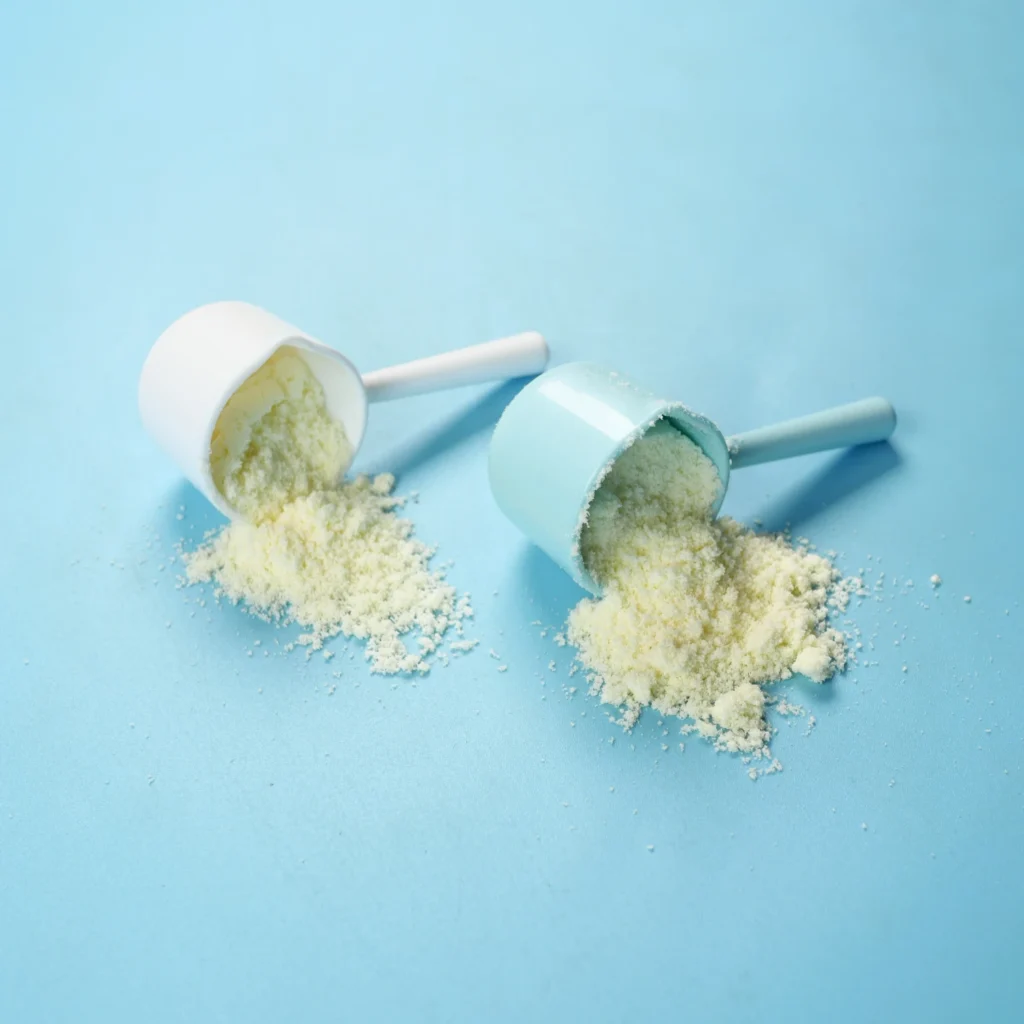
- Full Cream Goat Milk Powder supports structure, mouthfeel, and emulsion stability
- Skimmed Goat Milk Powder provides dairy solids while allowing independent fat control
- Goat Milk Protein Concentrates (MPC 60 and MPC 80) support protein density, viscosity, and structural performance
Selecting the right format early helps reduce reformulation cycles and improves control over final product behaviour.
Key Takeaway for Product Developers
Switching from cow milk to goat milk does not break a formulation.
It changes how that formulation reaches its final state.
When this shift is accounted for early, systems tend to stabilise more predictably and with fewer iterations.
When it is not, adjustments happen later and often focus on visible symptoms rather than underlying causes.
That is where most development time is lost.

Working with Goat Milk in Commercial Formulation
For teams moving into goat milk, the challenge is rarely feasibility.
It is achieving consistency and control across development, processing, and shelf life.
This is where reformulation shifts from trial-and-error to controlled adjustment within the system.
At The Milky Whey, we supply spray dried goat milk ingredients designed to perform reliably under real manufacturing conditions.
All ingredients are produced from 100 percent goat milk, with no carriers or additives, and supplied with a Certificate of Analysis for each batch.
If you are reformulating from cow milk to goat milk, or developing a new product, selecting the right format early can significantly reduce iteration time and improve formulation stability.
Visit our Goat Milk Protein Powders page, explore our technical resources, or contact our team to discuss your application or request a sample.